Showing posts with label Ammunition reloading. Show all posts

Monday, August 10, 2020

Loe..... It Has Come To Pass.... Ammo Is Gone


Not surprisingly, folks are a bit nervous these days. The reasons are many, and this post isn't really about politics or even about folks being just plain foolish.

But, the fact is; the 1st is just as important as the 2nd Amendment. That being said, all this "stuff" in combination with Covid-19, and everything else has created a run on gun stores the likes of which hasn't been seen for quite some time. 

Remember, these are "new" gun owners, meaning they don't have any ammo. It's not like me buying another 9mm with quite a lot of it put up. You combine all that with today's consumer going to Youtube for information and what you get is a bunch of new to the gun-world people watching videos telling them they should have at least a thousand rounds of ammunition for every caliber or every gun and there you go! Did I mention that it's also an election year with the results being very iffy regardless of which side you're on.

To give you an idea how bad it is out there; here's a little story. First, in case you haven't heard; nobody has ammo (other than pure hunting stuff like .243 Winchester). The big retailers are all out. The only places that have any are the small "mom & pop" gun stores like the one in my town. I was in there the other day, and sure enough, he had a case that he'd broken open and selling by the box instead of the whole 1000 rounds. A guy came in and wanted 2 boxes. THEY WERE $45 EACH!!! These were the normal 50 round boxes....

So, what do I do? More correctly; what did I do? The last 3 years after President Trump was elected, the firearms industry has experienced an epic slump. Everything from ARs,handguns, to ammunition was cheap. AR's between $400 and 500, $200 9mm semi-autos and 100 round boxes of 9mm at Walmart for less than $17. 

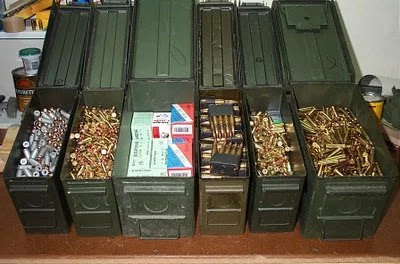
I filled up a 50 Cal ammo can with 14 boxes of this stuff, bought one or two at a time from 2017 to 2019 at about $17 per box, making it 17 cents per round. Over this same period, I bought close to 1500 rounds of .223/5.56 ammo at about 25 cents per round. The same goes for .22LR, 12 gauge shot shells of various types and some 300 Blackout as well. This is just the stuff that's sealed up in ammo cans waiting for a rainy day.

Just as, if not more importantly, I picked up several pounds of powders for each of my main calibers, several thousand primers and over a thousand projectiles. 

I'm not telling you all this to brag. What I'm saying is that I can still shoot because of the preparation work I did when times were good. I can shoot reloads because I have the supplies and equipment to make them. I have 22LR versions of my main guns (AR and Walther PPQ), so I can shoot that as well. I'm betting that, this too shall pass and prices will once again drop, but it's going to be awhile and I'll keep on shooting till then! 

Friday, December 6, 2019

The "A" in the "A Module"


As much as I love my firearms, the fact is; without cartridges, they are some high-priced paperweights! So, when it comes to getting prepared for scarcity, possibly sky-rocketing costs, one of the first things I prepared for was the ammunition. 


And it all started with being smart with the calibers I have guns cambered in, so I'm not trying to stock too many different types of ammunition. For handguns, it was a relatively easy choice. When you look at the factors of stopping power, common availability, cost, and a wide selection of firearms; it was pretty simply the 9 x 19, or Luger/Parabellum. That choice has allowed me to find both a "service" type weapon and a "concealed carry" option, along with a "pistol caliber carbine" that fit me. Why not the 40 S&W, which is more powerful? In my opinion, it's only marginally so, and more expensive to buy and shoot. It's also a caliber on the wane so would be more difficult to find in a pinch. Remember, the "9" is the primary caliber of both the armed services (in most of the world even) and civilian law enforcement agencies as well. 


My other main "stocking" caliber is of course ".223/5.56". It is again, an easy choice to make, being a standard of military and law enforcement. Depending on ammunition, it can be used on virtually anything ranging from small game to deer sized ammo. Now, before anybody gets all "up-in-arms"; I'm aware that it's not a legal deer hunting caliber in most states. However, in an extra-legal environment, this caliber can certainly bring down deer-sized game especially if used with heavier bullets like 77gr. I typically keep about 1500 rounds of this on-hand with three-quarters of it being the standard 55gr, but also keep 62gr "green-tip" as well and intend to have some of the heavy stuff as well. 


There is one other "standard" caliber that virtually everyone stocks (if they prep) and that's 22LR. It's cheap (right now), small and easy to keep. It's WAY quieter and easier to shoot than center-fire calibers. It can be a good bet to bring home small game and if push-comes-to-shove, it can be used for defense as well! While I try to keep around 1500 rounds in my other stocking calibers, I keep several thousand rounds of this. I keep two types; high-powered such as CCI Mini-Mags, but the majority of it is bulk/white-box stuff that's cheap to buy and store.


Then, there's the "others", stuff that I keep but don't keep a ton of around. Here they are and the reasons for their existence in my world:


Shot-shell. I have 12ga now in 00 Buck for home defense as well as some #4 shot. I also have some #6/7/8 "Birdshot" for food gathering purposes if it comes to that. I'm not a bird hunter, but anyone trying to bring home some food is more likely to hit something with a shotgun than a 22lr. If I pick up a 20ga, I'll pick up some shells for that as well. I don't keep a lot of this stuff. It's bulky (making it difficult to store) and I don't shoot it regularly, so I only have a couple of hundred round of it.


Then, there's the random center-fire. Although I've purposely kept my number of calibers to a minimum, I do have a few that aren't covered by the 9mm and 5.56. That's the 380acp and the 6.5 Grendel which I can shoot in an AR platform firearm and capable of bring down most anything in North America. Also, I keep ammo for the 300 Blackout giving me hog-hunting capabilities, it commonly runs wild throughout most of North Americas, but especially in the South. 


Along with factory-loaded ammunition, I also have the capability to reload/handload all of the above calibers with the exception of shotshells. Hopefully, this will not only be prepared for disasters of both natural, socio-economic and political. 

Friday, April 12, 2019

Casting New Light On My Reloading

This is about where I am these days with my reloading. A separate bench with 2 presses (more on this), and just about all the tools that I need. So, I'm pretty much a serious reloader/handloader with the ability to create any ammunition that I need, and make it in bulk if necessary. So, this is where the math begins to take over.
With my 9mm mainstay caliber, I can put together rounds at around .10 per, which is roughly half the "all-in" cost of off-the-shelf bulk or "white-box" ammunition. I can also save around the same .10 each on .223/5.56 too as long as I'm good at picking components. 
That's all the stuff, in this picture; powders, primers, and bullets. As it turns out, I can almost always find decent primers between $20 and $25 per 1000, which makes them about .02 ea. Pistol powder starts at about .01 per charge and tops out somewhere around .02 per, obviously not a real issue. Commercially purchased bullets range anywhere from .07 to .10 cents each. This basically adds up to anywhere from 10 cents to 14/15 cents per round for my 9mm loads. For .223/5.56, the powder charge is generally between 7 and 10 cents a round with the bullets starting at 11 up to around 15 cents ea. 
It doesn't take a rocket scientist to tell that the bulk of the cost of reloading is in the bullets themselves. Sure, you'll cut off around 10 cents per round off of any reloaded ammunition, but in order to change the supplies figure much at all, you'll have to do something about the cost of bullets! How does one do that? There are actually more than one way:
  • Buy them is big bulk lots of 5000 or more. This isn't much of an option for me since the is a hobby oriented toward to low end.
  • Buy "pulls". These are literally what the name implies; where actual bullets are pulled from completed cartridges that either failed inspection or are contract over-runs etc. I might go this route as I learn more about them.
  • Casting my own from lead. And this is obviously where this post is going....
I've always been interested in this off-shoot of an off-shoot part of the hobby. There is something about taking scrap and turning it into something useful that appeals to me. And that it's another kind of a "throw-back" skill interest me as well. Unfortunately, the downside is that at this point, it's a little late in the game to get into the process..... however, let me apply some history and analytics to the issue and show what I've learned.
 
Let me start here. At one time, aspiring bullet casters started by going to the friendly local tire shop and asking them for their buckets of scrap lead wheel weights. Then, they go home and get out an old cast iron pot, melt them down, skim off the dross (crud) and pour them out into ingots, which eventually ended up in a casting pot to be molded into bullets. Simple enough and all for about $0! Then this happened.
By executive order, then President Obama pretty much did away with the use of lead in virtually all aspects of the U.S., ......including the rather prosaic wheel weight. 
These days, chasing down lead is something akin to some sort of post-apocalyptic scavenging. Anyway; enough on that rant. How does an aspiring bullet caster set about gathering some precious grey booty?
.....Uhhhh, eBay of course!!! Or even Etsy, but yeah. There are folks out there who have the time to go chase down the many tons of lead that's still out there and are happy to sell it to those of us who don't.
Let's look at the economics of it then. I did some calculations yesterday and here's what I found using a price of $1.50 per pound which I can find pretty easily (both locally and through the Internet)...
  • Typical 115gr bullets used for 9mm Lugers like I shoot cost about .02 each to make.
  • Typical 55gr bullets used for .223/5.56 "NATO" like my AR shoots are about .01 each.
  • That's a savings of anywhere from 5 to 10 cents per round, which is like taking the savings from reloading (which is roughly half of commercial) and halving it again!
Wow! Why wouldn't ya! OK, there's equipment involved such as a pot, molds and a few other incidentals, but still..... My pot was bought second hand for about $40, my one 9mm mold was about $15. I'm going to get a 6-cavity mold for 9mm as well as one for 223 which will run about $50 apiece. I'll need to pick up some powder coating materials and a toaster oven from Goodwill ($10), but that won't cast much at all. I'll get into the casting and powder coating in a future post.
Is all this going to turn me into a crazed shooter, out every weekend doing mag-dumps in the woods? No, not really my style. However, when I do go shooting, the cost will be about as far down as I can make them. Sure, the current cost of ammunition is at an all-time low (inflation adjusted), but how long do you figure that's going to last? Till the next election maybe? For me, I'm going to be ready.
  
The two images above show the current state of my reloading bench. With the Lee Classic Turret press up and running and the Inline Fabrication's Case Ejector system installed, I can now easily crank out around 100 rounds in an hour. That's not anywhere close to the speed of "progressive" presses, but it's "cranking it out" in my world. What it really does though is shift the bottle-neck from speed of production to cost of components. Hopefully, that's something that bullet casting will resolve for me. I'll keep you posted.

Sunday, November 26, 2017

Sensible Ammo Accumulation: Part 2

Last post, I talked about ammo accumulation in a sensible manner and how not to break the budget doing it. Yesterday, I took my own personal plan to the second stage.
 
After 3 hours of alternately watching YouTube videos on reloading, and replicating it on my new press, this was the result! OK, that's just 100 of them, so there are about 25 more in another box, but you get the idea. So, let me start at the beginning.....
Over the course of the last couple of months, pretty much as soon as I bought my pistol, I started buying up reloading equipment. Here's the basics in a dollar and cents way. Practice/ball ammo costs something like $20 to $30 per 100 rounds purchased where normal people do their buying; eg. Walmart, or one of the big box sporting goods places such as Academy, Bass Pro etc. That's 20 cents pull per round for the 9mm that I shoot. So you go to the range and on a good day, you shoot something like 200 rounds. That's $40+, and if you average that over a year; you're looking at something like $480-500. After judicious buying, I've got $150 in my equipment to product 9mm rounds. Based on some rather conservative calculation, that's about 10 cents each, meaning that I'll save about $240-250 in my first year of shooting alone. Uhhhh..... what's not to like here? Let's break this down some.
Since I'm mostly going to be shooting 9mm, I'll use that to start. I bought a cheap and simple Lee "Breech Lock" single stage press directly from Lee Precision as a "factory second" for about $35. I'll be able to use this little press for cartridges up through the 30-06, so it's size and ability is going to be beyond my needs for some time. I found from looking at retailers (both online as well as brick and mortar), and at gun shows, that this was the best price I could get. Plus it's new, factory direct, it would have the Lee warranty. I'm not going to get into a ton of detail, here, but I bought all the other small/smaller items either from Lee, or online some place. They ranged from shell holders which are specific to the cartridge case all the way to the powder measure and scale. Why didn't I buy a whole kit for about $150-170? One reason. 
Notice anything about this fine reloading kit from Lee Precision? No Dies! I'm not picking on Lee here. None of the manufacturers kits come with those.
Ya gotta have a set of those for each and every caliber that you plan on reloading. I also wanted to have a set with the carbide inserts so I wouldn't have to lubricate my cases. These are somewhere between $35 and $50 all by themselves! My total of $150 includes the set I bought on Craigslist. Mine are RCBS as pictured above, but the brand isn't all the relevant. These parts are pretty simple and the price doesn't vary a whole lot unless you want to buy the really expensive stuff, so it didn't occupy a lot of my time. What did?
This!!! Sorting through the bewildering array of supplies just about drove me to distraction! Luckily, I already knew the terminology from my last foray into firearms, but just the variety of what's out there is more than a little intimidating! So, let's break this down.
If you look at the cut open 9mm cartridge above, you'll see 4 components: 
  1. The cartridge itself, which is the easy part. I had about 150 picked up from the range in Amarillo, cleaned, with the old primer punched out and ready to load. They do need to be inspected and any flawed ones (like the 2 that developed cracks when I sized them), need to be thrown out. Then the primer pocket has to be cleaned with a little tool designed for that. 
  2. The primer, which is that little plug like thing that goes in the bottom of the cartridge. It's the most volatile of the component. The 9mm takes one size which is called "small pistol". No need for the "magnum" type. It's a simple cartridge that doesn't hold a lot of powder. You do need to decide on the brand though. I found a guy locally who had many 10's of thousands of Tul that he hoarded in case the last election went bad. I bought a 1000 for $26. That's $14 cheaper than the nicer CCI or Winchester brands, but it's range ammo and I just need it to go "bang".
  3. The powder is next, and there are a bewildering variety of this. I'll probably write a separate post on just this alone, but in this case (literally), I went with an easy to use meaning that it "throws well" out of a powder measure which throws by volume. I used Hodgdon HP-38, which is the rebranded Winchester 231. This doesn't generate the greatest velocities, but is efficient (lots of loads per the 1 pound bottle) and tends not to be very sensitive. Perfect for a first time reloader like me!
  4. Then there's the bullet itself. This is the singe most expensive component in the process. Typically, if you run down to Academy, you can spend around 15-20 cents each for jacketed. Or you can order some copper coated/plated for about 10-15 cents each. Why not lead? Many ranges and virtually all indoor ranges don't allow it. Sure you can cast your own, then powder coat it in the oven, but it's a huge hassle. So I went with a polymer coated lead which cost me about 7 cents each at the 115 grain bullet. This can be a huge headache as well since there's quite a range of weights and types, shapes and construction as well. I just went with a weight, and shape similar to the type I routinely buy anyway.
Obviously, there are a lot of factors and the costs can vary a lot. Here's how it come out for this very basic load. The bullet at 7 cents, the powder at 1 cent, the primer at 2.6 cents, equals 10.6 cents per round, or $106 for the thousand.
That's roughly half price for the cheapest ammo to buy! When you start looking at more costly calibers, it's even more attractive.
Let's use another common chambering out there; the 243 Winchester which is the defacto standard for deer in the South. It's sells off the shelf for about 80 to 90 cents per round for the inexpensive stuff. After a quick calculation, it would reload for about 20 cents each. That's saving 60 to 70 cents per round making the 100 round saving in the $60-70 range! Wow! Why wouldn't ya?
I've only discussed the basics and the most inexpensive scenarios. It can get wild if you were to reload exotics, or big bore calibers. For, me, it's not about that. Obviously, it will allow me to be able to shoot more for less money, but there are two other benefits that are just as, if not more important to me. First of all; if things go bad in the next election and we get another "Clinton" in the Oval Office, I can load my own and be more insulated from that situation. But secondly and arguable, more important to me, is that I've found it to be strangely therapeutic. Sure, it's precise and demanding, but it's a fit for me.